
Sharp County Court Records After Arrest
A Sharp County jail arrest starts with a booking at the Sharp County Detention Center or a hold lodged there by the sheriff, a city police agency, or another court-related authority. The jail roster can show the arrested date, arresting agency, booking charge, bond, posted court date, and court label, including Sharp Co District or Sharp Co Circuit Court. The sheriff's jail materials name Sheriff Shane Russell, while the court case moves through a separate prosecutor and court system. Those fields are useful, but they are not the same as the formal court record. The formal record is the case file opened or updated after the prosecutor files a charge in court.
That split matters for anyone comparing custody, charges, and court records after an arrest. The roster is the best starting point for custody and booking facts, while the Arkansas Judiciary case system is the best online source for the court case. For custody fields, use the Sharp County jail inmate records page. For booking photos, use the Sharp County jail mugshots page. Court records after a jail arrest should be read as filed accusations and case events, not proof that the person was convicted.
The prosecutor for Sharp County is the Third Judicial District Prosecuting Attorney. The district covers Sharp, Jackson, Lawrence, and Randolph Counties. The Sharp County deputy prosecutor office is listed in Ash Flat, and the district prosecutor site points users to Arkansas CourtConnect or caseinfo for criminal case files by defendant name and county.
Find Sharp County Court Records
The online search route for court records after a Sharp County arrest is Arkansas Judiciary Case Search. The visible search interface defaults to participant search and includes first, middle, and last name fields, an organization or case-description field, a search button, and an advanced filters button. The prosecutor's public guidance tells users to search the defendant's name and include the county where the offense occurred when trying to find the case file.
- Start with the Sharp County roster to collect the name, arrested date, booking charge, bond field, and court label.
- Open Arkansas Judiciary Case Search and search by defendant name or case number if one is known.
- Narrow the result to Sharp County, Sharp Co District, or Sharp Co Circuit Court when the search filters allow it.
- Open the case and compare the filed court charges with the booking charges shown on the jail roster.
- Check each charge status, event, hearing date, bond order, and disposition field before drawing a conclusion.
If a case is too new to appear, the court record may not have been filed or indexed yet. If the roster shows a court date but the public search does not return a clear case, use the court clerk or prosecutor route rather than assuming the charge was dropped. Older, sealed, juvenile, or protected matters may also fail to appear in the public case search.
| Field Label | Type | Required | Options / Format Notes |
|---|---|---|---|
| Search by / search context | Dropdown | Optional | Visible default is Participants; other choices may appear in the live interface. |
| First Name | Text | Optional | Participant search field, with a long text limit in the interface. |
| Middle Name | Text | Optional | Helpful when a common name returns several Arkansas cases. |
| Last Name | Text | Optional | The main field for a defendant-name search. |
| Organization or Case Description | Text | Optional | Alternate field shown on the public interface. |
| Advanced filters | Button | Optional | May allow tighter filtering, but the full filter list was not captured in static source. |
The Arkansas Judiciary case-search screen is the state portal used to move from a jail arrest clue to a filed court record.
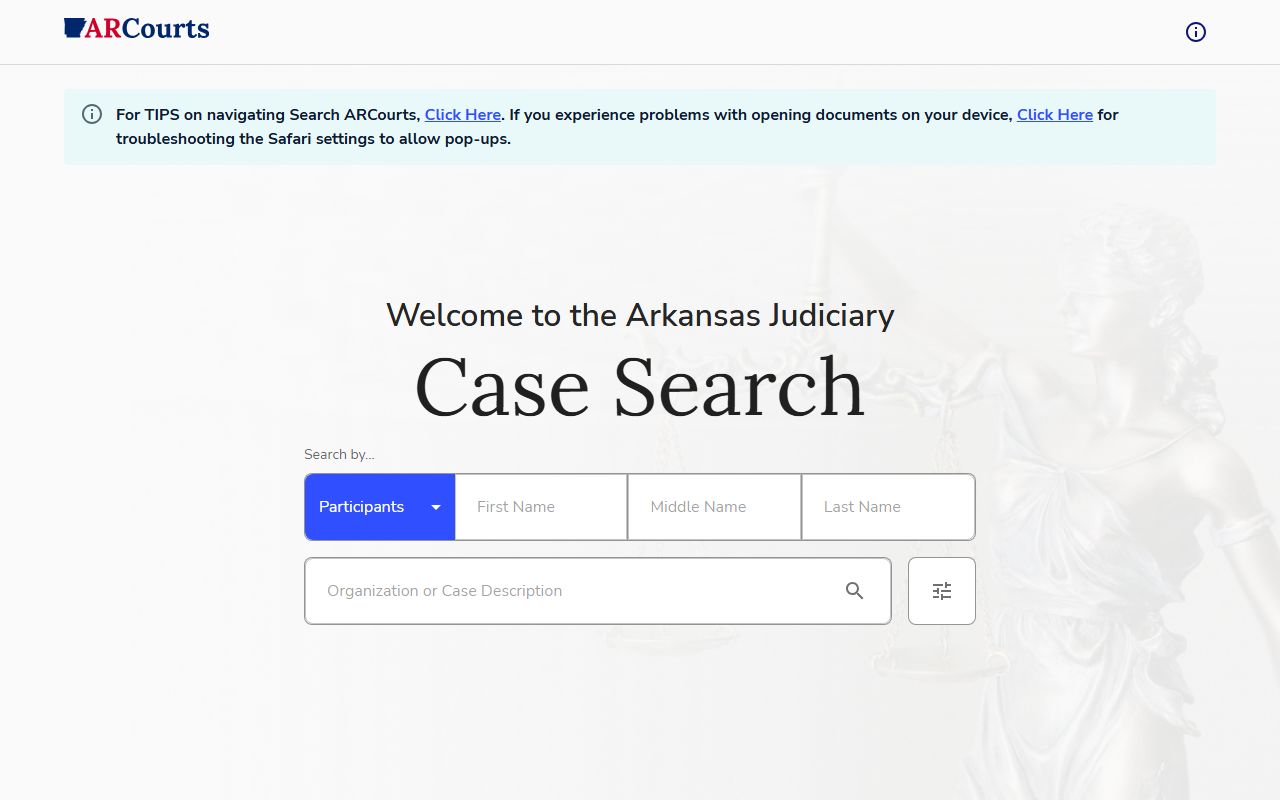
The case-search image matches the court-record lookup path because the public jail roster does not replace the court file.
Sharp County Arrest Charging Documents
After arrest and booking, the charge record can move through different charging documents. The research did not identify one single document type for every Sharp County case, so the safer reading is that misdemeanor, traffic, felony, and grand-jury matters can reach court in different ways. A complaint, information, or indictment starts or frames the formal accusation, while later court entries may amend, reduce, dismiss, or resolve the charge.
| Document | Usually Filed By | Common Use | What to Check |
|---|---|---|---|
| Complaint | Officer or prosecutor | Often used to begin lower-court or initial criminal matters | Defendant name, offense date, charge text, court, and bond or appearance terms |
| Information | Prosecutor | Common formal charging document for many felony cases | Filed charges, offense level, amendments, and prosecutor signature |
| Indictment | Grand jury | Used in serious cases when a grand jury returns charges | Count numbers, offense language, and later court orders |
Booking charges are often brief labels written at intake. Court charges are filed in the case system. The wording can differ because the Third Judicial District Prosecuting Attorney reviews the facts, evidence, law, and procedural posture before deciding what to pursue. A roster line can remain useful, but the court record controls the filed case.
Sharp County Charge Status
Charge status tells where a court record stands after the jail arrest. A pending charge is still open. An amended or reduced charge means the filed accusation changed. A dismissed charge means that count did not continue to judgment. A nolle prosequi entry, often shortened to nolle pros, means the prosecutor chose not to proceed on that charge at that stage. These terms do not all mean the same thing, so each count should be read on its own line.
| Status | What It Means | What It Does Not Prove |
|---|---|---|
| Pending | The court case or charge is still open. | It is not a conviction. |
| Amended | The prosecutor or court changed the charge wording, level, or count. | It does not mean the original booking label was final. |
| Reduced | The charge moved to a lesser offense or lower level. | It does not erase the case history unless later sealed. |
| Dismissed | The count was ended by court action. | It does not automatically remove every public record. |
| Nolle Prosequi | The prosecutor declined to proceed on the charge at that point. | It is not a guilty finding. |
| Convicted / Guilty Plea | The case ended in a conviction by plea or finding. | It should be verified against the final disposition. |
When a Sharp County court record has several counts, one count may be dismissed while another remains pending or ends in a plea. Read the docket and disposition fields before relying on a single roster charge. If the case is sealed or protected by court rule, the public search may omit the record or limit the detail shown.
Bond After Sharp County Arrest
Bond appears in both jail and court contexts. The Sharp County FAQ says the Sheriff's Office accepts cash bond or surety bond from a licensed bail bonding company when a bond is set. It also says the sheriff will not accept or approve an own-recognizance bond or property bond at the jail. That local statement should be read with care because judges and courts still make release decisions. The jail is describing what it will accept or approve through the sheriff's office.
| Bond Type | How It Works in Sharp County Records |
|---|---|
| Cash Bond | The full cash amount may be accepted by the sheriff when bond has been set. |
| Surety Bond | A licensed bail bonding company posts the bond, and the sheriff FAQ says surety bonds are accepted. |
| Own Recognizance / PR | Release on a promise to appear must come from court authority; the sheriff FAQ says the office will not accept or approve it locally. |
| Property Bond | The sheriff FAQ says property bonds are not accepted or approved by the office. |
| No-Bond Hold | The person must remain in custody until a judge or court action changes the hold. |
| Other-Agency Hold | A hold for another county, state, parole, probation, federal, or immigration matter may block release. |
Roster bond amounts are not a release guarantee. A court order, new warrant, parole or probation matter, or hold for another county or state can keep a person in custody after a local bond is addressed. Verify the court record, then call the jail before travel or payment.
Warrants Before Sharp County Arrest
No standalone Sharp County active-warrant search portal was located in the research. The sheriff FAQ says the office maintains thousands of arrest warrants from District Court and Circuit Court and that warrants are public records under Arkansas FOIA. A caller can obtain warrant date, charges, bond amount, and issuing court by calling the Sheriff's Office. The Most Wanted page is a selected wanted-person list, not a complete warrant database.
Warrants can be the reason a person is booked into the jail. Some warrants carry a bond amount. Others are no-bond warrants, which require the person to stay in custody until appearing before a judge. Misdemeanor arrest warrants may be served in Arkansas, while felony warrants may be extraditable nationwide under the sheriff FAQ. Court records can also show bench warrants and failure-to-appear events tied to an existing case.
For warrant-related court records after a jail arrest, compare three sources: the sheriff warrant information route, the jail roster if the person was booked, and Arkansas Judiciary Case Search for the pending case. The most complete picture often comes from matching all three.
Sharp County Charges vs Convictions
An arrest, a booking charge, a filed charge, and a conviction are separate events. Court records after a jail arrest often begin with accusations. They may later show a plea, trial result, dismissal, diversion, amended count, or sentence. Treating every charge as a conviction creates a serious error, especially when the roster has not caught up with prosecutor or court action.
| Point of Comparison | Charge | Conviction |
|---|---|---|
| Meaning | An accusation filed or listed after arrest. | A guilty plea, verdict, or other finding that ends in guilt. |
| Stage | Early or mid-case. | Final or near-final case outcome. |
| Proof Level | Based on probable cause or prosecutor filing decision. | Requires proof beyond a reasonable doubt or a knowing plea. |
| Record Source | Roster and court charge entries. | Final court disposition and sentencing entries. |
| Public Meaning | Shows what was alleged. | Shows legal guilt, subject to appeal or later sealing. |
Sealed Sharp County Court Records
Arkansas access rules include important limits. Arkansas FOIA, Ark. Code Ann. 25-19-105, allows public access to records unless an exemption applies. It also exempts undisclosed law-enforcement investigations and documents protected from disclosure by court order or court rule. The sheriff FAQ adds local caveats for open or active investigations, personnel records, sealed or expunged records, and juvenile records.
| Point of Comparison | Sealed | Expunged |
|---|---|---|
| Public Access | Hidden or restricted from ordinary public view by court order or rule. | Often used in Arkansas as part of record-sealing language for eligible cases. |
| Record Custodian | Court, law-enforcement, and state repositories may apply access limits. | The court and ACIC-related process may control what is released. |
| Eligibility | Depends on disposition, offense type, waiting period, and court order. | Ark. Code Ann. 16-90-1406 addresses eligibility for certain felony sealing after sentence completion and waiting periods. |
| Effect on Search Results | The public case search may show less detail or no record. | Public background and case searches may be limited after the order is processed. |
| What to Do | Ask the court clerk or record custodian about the order. | Use the court and Arkansas Crime Information Center process where applicable. |
Juvenile matters are especially restricted. The prosecutor site states juvenile matters cannot be discussed with anyone other than parties, parents or legal guardians, and the attorney of record. If a public search omits a juvenile or sealed matter, that gap may reflect law rather than a data error.
Restricted Sharp County Arrest Records
Some records tied to arrest and court activity are public. Some are not. Active investigative material may be withheld under Arkansas FOIA. A court order or court rule can block release. Juvenile records can have separate statutory limits. The sheriff FAQ also says the office will not provide ACIC or NCIC criminal-history background information and will not compile statistical or comparative data for requesters.
That means a person may find a roster entry, then find no matching public court record, or find a court record without every report, supplement, photo, or investigative detail. For a report copy, the sheriff FAQ says accident and incident reports taken by county officers are requested at the Sheriff's Office or jail front desk for a stated report fee during weekday office hours. Reports taken by city officers must be requested from that city police department.
Important: Do not use public arrest, jail, or court data for credit, housing, employment, insurance, tenant screening, or any FCRA-covered decision.